
How Emotional Literacy Can Reduce Bullying Before It Begins
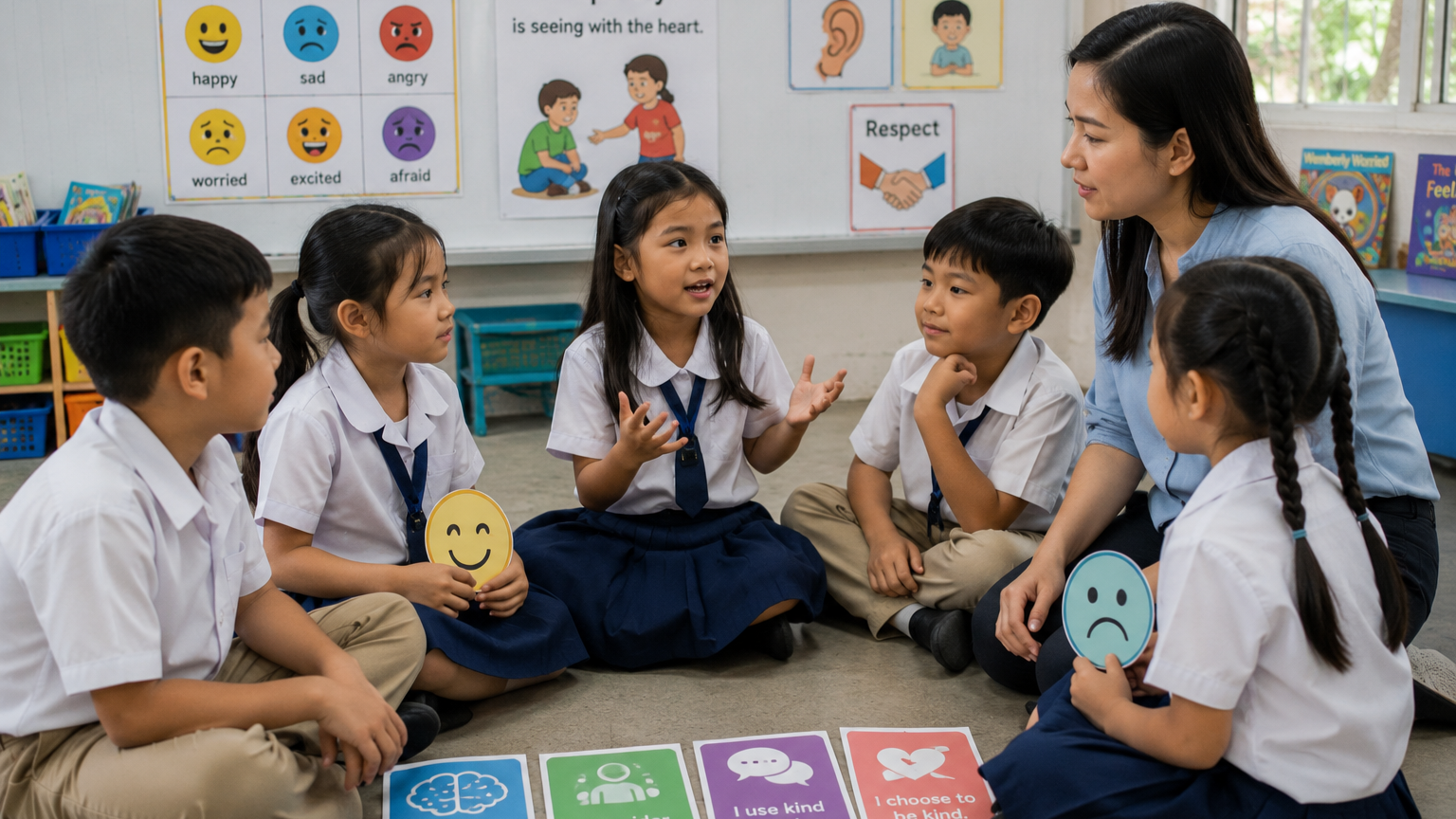
Imagine trying to stop a tree from growing. Once it has matured, the work becomes difficult. Its roots have spread. Its trunk has strengthened. Its branches have grown.
Now imagine planting a different seed. The outcome changes because the beginning changed.
Bullying is much the same. Most schools respond after bullying appears. We ask: "What if we started much earlier?" What if we intentionally taught children the emotional skills that help prevent bullying from taking root in the first place?
Every Behavior Begins Somewhere
Children are not born knowing how to:
Empathize
regulate emotions
resolve conflict
communicate respectfully
understand another person's perspective
These are learned skills. Unfortunately, if we do not intentionally teach them, children often learn from whatever environment surrounds them. Sometimes that environment teaches compassion. Sometimes it teaches aggression. Children are always learning. The question is: What are they learning?
Emotional Illiteracy Has Consequences
Imagine a child who feels:
Embarrassed
Jealous
Rejected
Disappointed
ashamed
But lacks the words to describe those feelings. The emotion still exists. The child simply cannot express it in healthy ways. Often emotions that cannot be expressed become behaviors that can be seen. Sometimes:
hurt becomes anger.
Fear becomes aggression.
Shame becomes ridicule.
Loneliness becomes exclusion.
Not because children are cruel by nature but because they have not yet learned another way.
Emotional Literacy Gives Children Choices
One of the greatest gifts we can give children is language. Not only academic language - emotional language. When children learn to say:
"I feel left out."
"I feel embarrassed."
"I'm frustrated."
"I'm nervous."
"I'm disappointed."
they become less likely to express those emotions through harmful behavior. Naming emotions creates awareness. Awareness creates choice. Choice creates healthier behavior.
Empathy Can Be Taught
Many people believe empathy is simply part of personality. We believe empathy can be developed. Children can learn to ask:
How would I feel?
What might they be experiencing?
How could my words affect them?
Empathy slows judgment. Empathy softens conflict. Empathy interrupts cruelty. It helps children recognize that every classmate carries feelings as real as their own.
Self-Awareness Comes First
One of the greatest discoveries in emotional intelligence is this: Children who understand themselves are better able to understand others.
A child who recognizes: "I'm feeling jealous." , is less likely to express jealousy through bullying.
A child who recognizes: "I'm feeling hurt." , is more likely to seek help than seek revenge.
Self-awareness becomes the doorway to healthier relationships.
Classrooms Become Emotional Laboratories
Every classroom teaches far more than academic subjects. Every classroom teaches children:
How disagreements are handled.
How mistakes are treated.
How differences are respected.
How kindness is modeled.
How adults respond under pressure.
Children are studying human behavior every day. Teachers become emotional role models whether they realize it or not.
Small Daily Moments Matter
Bullying prevention does not happen during one annual assembly. It happens in thousands of ordinary moments:
Greeting students by name.
Celebrating kindness.
Helping children resolve conflict.
Encouraging empathy.
Teaching emotional vocabulary.
Recognizing courage.
Modeling respect.
Culture is built one interaction at a time.
A Biblical Perspective
Jesus gave His followers a remarkably simple instruction: "Do to others as you would have them do to you." (Luke 6:31)
Imagine if every child learned to pause before speaking and quietly ask: "Would I want someone to say this to me?"
This is emotional intelligence expressed through love.
A Different Perspective
We believe schools should not wait until children hurt one another before teaching relationship skills. Instead, we intentionally develop:
self-awareness
emotional regulation
empathy
communication
gratitude
compassion
conflict resolution
healthy boundaries
These are not "extra" lessons. They are life skills. Academic success prepares children for careers. Emotional intelligence prepares them for relationships. Both matter. But relationships shape societies.
The Long-Term Vision
Imagine students who graduate not only knowing mathematics and science, but also knowing:
How to apologize.
How to forgive.
How to regulate anger.
How to express disappointment respectfully.
How to encourage others.
How to stand beside someone being mistreated.
Imagine classrooms where kindness becomes contagious. Where courage becomes normal. Where belonging becomes expected. Where bullying finds very little room to grow. This is not wishful thinking. It begins one lesson, one teacher, one classroom, one child at a time.
A Good Reflection
Perhaps the greatest anti-bullying program is not a program at all. Perhaps it is a generation intentionally taught how to understand themselves and care for one another.
When children learn emotional literacy, they begin recognizing emotions before behaviors. When they learn empathy, they begin seeing people instead of problems.
When they learn courage, they begin protecting rather than remaining silent.
And when schools intentionally develop the whole human being, they do more than prevent bullying. They help raise a generation capable of building healthier families, stronger communities, and a more compassionate world.